ACGA’s Japan delegation in September took place after a series of significant regulatory reforms over the prior six months. The most notable was the revisions to the Corporate Governance (CG) Code. These measures, along with other changes proposed and approved in relatively quick succession, including an update to the M&A guidelines, the push for value-creating growth and revised guidelines of foreign takeovers, have raised concerns that shareholder rights may be diluted as national priorities shift towards growth investments. The most significant reforms still ahead are amendments to the Companies Act which the Ministry of Justice and its committees are currently discussing, and which are expected to be tabled in the Diet by March 2027.
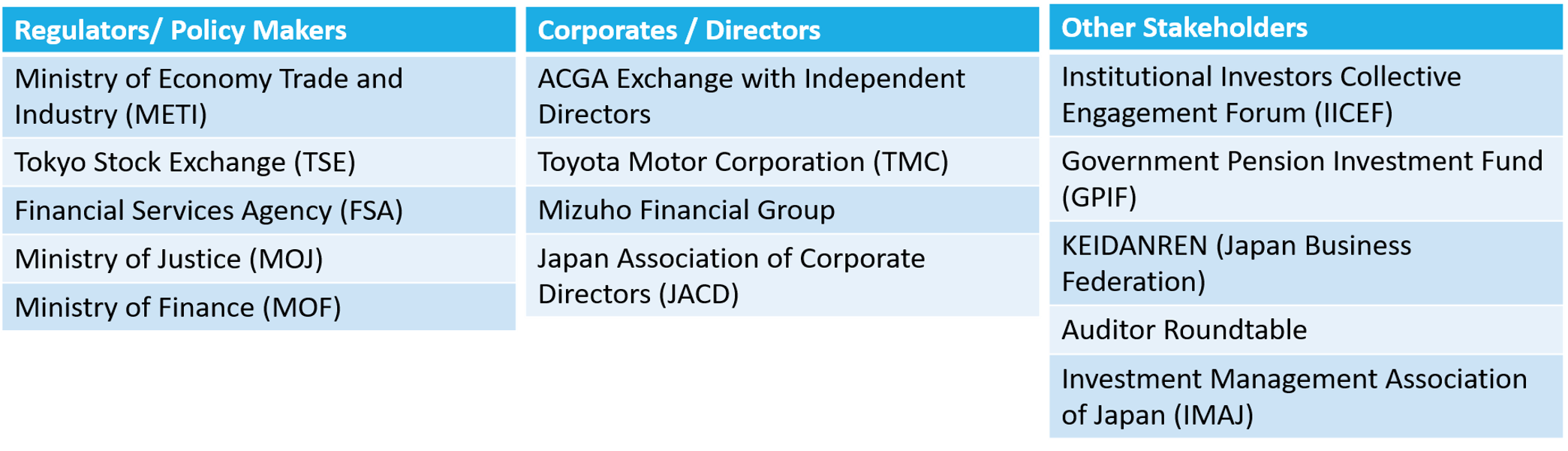
The delegation met with all the relevant regulators and policy makers, including the Tokyo Stock Exchange (TSE), the Financial Services Agency (FSA), the Ministry of Economy, Trade and Industry (METI). ACGA also held its first in-person meetings with Ministry of Finance and the Ministry of Justice officials. Other key stakeholder meetings are shown in the table below.
ACGA Japan Delegation 2026 meetings
The recent regulatory changes formed a common backdrop across most of the meetings. The TSE and FSA stressed that while the CG Code principles have been streamlined significantly – from 83 to 30 – the aim is to move companies away from the box-ticking compliance which arose the previous length of the Code. Under the reduced set of comply-or-explain principles, companies are still expected to determine and disclose what is relevant to investors. According to the regulators, this puts greater responsibility on company boards and is intended to raise the bar on board accountability.
Both TSE and FSA emphasised that companies must explain how their governance structures support long-term value creation and capital allocation decisions. Similar views were expressed at other meetings. including those with independent directors and the investor association. The FSA indicated that it will review disclosures in companies’ annual reports and corporate governance statements next year to assess the implementation of the new CG code guidelines. It continues to welcome feedback from investors as they examine these disclosures in the year ahead.
The directors at METI clarified that revisions to M&A guidance are not intended to reduce the importance of price in acquisition decisions; rather, companies should explain intangible assets, human capital and long-term value considerations when evaluating offers. They assert that rejecting a significantly attractive bid would be difficult, given boards' accountability to shareholders. Concerns however remain that non-price considerations emphasised in METI’s updated guidelines may give boards flexibility to recommend rejecting takeover offers even if the offer price may be attractive. Ultimately, however, investors retain the right to decide through their vote, which remains a feature of the guidelines.
METI reiterated concerns that decades of deflation have led Japanese companies to prioritise employment stability over profitability and investment efficiency. This contributed to weak capital allocation, low returns and limited productivity growth. Policymakers now would like companies to direct resources toward businesses capable of generating attractive returns, including return on invested capital (ROIC) above weight cost of capital (WACC), while maintaining an appropriate balance between shareholder returns and investment for future growth.
A striking statistic in the METI consultation(1) was that 65% of capital employed by Japanese companies generates negative economic profit (i.e. ROIC below WACC) compared to approximately 40% in Europe and the United States. From ACGA’s perspective, this underscores the need for strong board oversight on capital investment decisions including monitoring how these investments are progressing. The concern is the risk of throwing good money after bad: after a decision to invest is made, where returns are below expectations management may be tempted to commit further capital in the hope of improving returns. Unless key performance indicators (KPIs) are tied to profitability and relevant financial ratios, there is a risk of losses being considered “good” and necessary to for business expansion. This might result in reluctance to accept that a poor investment decision was made and to cut “bad” losses. The need for more effective incentives was a recurring theme in a number of the meetings. Participants generally supported wider disclosure of metrics such as ROIC, ROE, WACC and TSR to help investors assess management performance.
The most significant regulatory change still to come is to the Companies Act. Policy makers are concerned about collusion among activist investors with private equity firms to take control of companies and potentially thereafter undermine their value through asset stripping, reduced capital expenditure and slashing R&D. References to ‘wolf pack’ strategies have been frequently cited, including in the media. The risk is that a few bad actors – not primarily foreign and certainly not all activists - may affect the playing field and result in regulations that would affect all investors.
Among the proposed changes to the Companies Act is a provision to suspend voting rights of shareholders who breach disclosure regulations on their holdings. ACGA’s members expressed concern that shareholding reporting errors are most commonly the result of errors arising in the custody chain by custodians, nominee companies and trust banks. Potential administrative errors could undermine asset managers’ ability to exercise their fiduciary responsibility of voting on behalf of shareholders. Other potential legislative amendments include lifting the thresholds for submitting shareholder proposals and for convening extraordinary shareholder meetings (EGMs), as well as restricting shareholder proposals from what may be deemed operational matters. ACGA has submitted an initial response to the consultation on the proposed Companies Act amendments(2). As additional proposals are being included, we will follow up in writing to the authorities on the additional proposals, reflecting the investor views expressed during the delegation.
These changes come at a pivotal time for CG reform in Japan. The momentum sparked by the “Action Programme for Accelerating Corporate Governance Reform: From Form to Substance”, introduced by the FSA in 2023 for companies to prioritise shareholder value appears to remain intact.(3) The capital market has seen a marked increase in M&A activity in the period since the 2023 METI Guidelines for Corporate Takeovers were published. Yet there seems to be a view in some quarters that the reforms may have gone too far, with concern that discretion is being removed from management and company boards. Despite a reported decrease in companies with low valuations, much remains to be done to improve financial returns in the Japanese market.(4) The focus on capital efficiency, board oversight and fiduciary responsibility of investors needs to remain steadfast for Japan to maintain its pole position on CG reform regionally.
Footnotes
About the Author(s)
 Amar Gill
Secretary General, ACGA


 Old Site
