

 Old Site
Book review: Navigating Sustainability In Asia
by Amar Gill, Secretary General
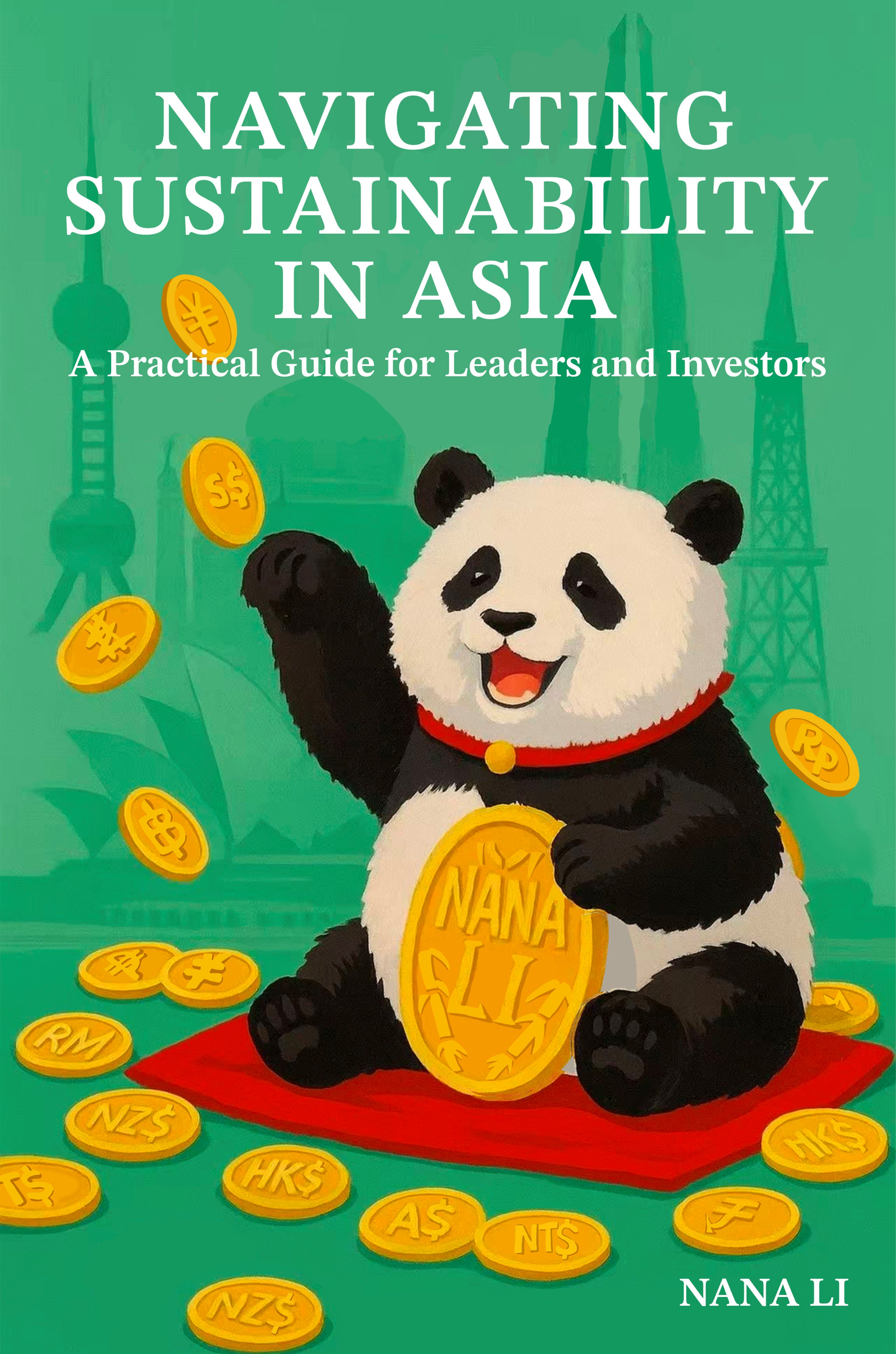
Navigating Sustainability in Asia is an urgent book written for investors, corporate executives in Asia and beyond, as well as regulators. Nana Li, the author, is Asia Pacific Head of Sustainability and Stewardship at Impax Asset Management where she leads research, engagement and policy advocacy across the region. Nana was previously Research and Project Director at the Asian Corporate Governance Association (ACGA) and continues to be Special Advisor for China and ACGA’s Chair of its China Working Group. Her global overview and how it relates to Asia comes also from serving on the IFRS Sustainability Reference Group and the International Corporate Governance Network’s (ICGN) Global Policy Committee. Nana deploys her global experience and deep knowledge of the Asian region very effectively in the book with examples and case studies of companies in Europe and the US that have failed to live up to sustainability commitments and the dire consequences they faced.
The book focuses on sustainability challenges in Asia. Climate change poses significant risks for this region, particularly vulnerable due to its dense populations, extensive coastlines and reliance on agriculture. Nana writes with a sharp awareness of the complexity of the immediate situation. “The region is the world’s most disaster-prone area, facing intensifying flood, drought, typhoons and glacial melt. These climate related disasters not only threaten lives and livelihoods but also disrupt economic activities and infrastructure, making it imperative for Asian countries to adopt to climate policies and adaptation strategies.”
In her view, regulators and corporates are disproportionately focused on transitional risks – the financial and reputational challenges that arise from the transition toward a low-carbon economy. She notes a lack of discussion around physical climate risks – the direct impacts of climate change including extreme weather events, rising sea levels and temperature change. During engagements as an investor, Nana finds that the responses from corporates can be glib and complacent. “When it rains, we close the door!”, she quotes an executive from a multinational manufacturer in China.
The book has a wealth of insight and perspectives from her own engagements and work with related investor groups. The challenges faced in Asia are immense and carry significant global repercussions. The region accounts for 81% of global weather-related disaster deaths, with floods and storms causing US$36 billion in losses in 2023. But institutional focus remains skewed: only three Asian markets – Singapore, Hong Kong, Japan – currently mandate physical risk disclosure while corporate adaptation budgets average just 12% of mitigation spending. “Until boards treat flood-proofing with the same urgency as carbon accounting, Asia’s US$1.7 trillion in exposed coastal assets will remain at peril,” Nana writes.
Sustainability is not just about climate. Labour and social issues are likely to get a larger focus in her view. The region’s factories and worksites employ over one billion people, yet 65% of Southeast Asia’s workforce remains in vulnerable employment without social protections. Meanwhile, Australia is reviewing its Modern Slavery Act which Nana sees as an early benchmark for Asia Pacific. The reform momentum is pushing companies toward higher accountability: jurisdictions including South Korea and Thailand are moving toward mandatory due diligence which she expects will slowly reset the regional baseline for supply chain transparency and risk management.
As global supply chains face increasing scrutiny, companies that institutionalise fair wages and safe conditions are not just mitigating risks but securing access to premium markets and talent in Asia’s tightening labour pool. But a significant challenge is the lack of strong regulatory frameworks and enforcement mechanisms. The implementation of labour laws is often weak due to corruption, lack of resources, and political influence. Nana considers these to be systemic issues that she has repeatedly encountered as an investor.
The book has a chapter on do’s and dont’s of navigating environmental, social and governance (ESG) issues and sustainability in Asia, as well as chapters specifically on Greater China, Japan, South Korea, India, ASEAN as well as Australia and New Zealand. It closes with a chapter on the future of sustainable investment in Asia. Nana is optimistic that the current backlash against ESG and sustainability practices in the United States will not have a significant impact here. In her view, the region’s commitment to sustainability is driven by a combination of regulatory mandates, market demands and societal expectations. Meanwhile China’s rise as a global economic powerhouse will play a significant role. China’s substantial investments in renewable energy, electric vehicles, and green technologies are setting new benchmarks for sustainability practice. A leader in the global energy transition, its leadership position enhances China’s influence within Asia and attracts international investors keen to align with sustainable growth trajectories, she writes.
The disclosure of sustainability-related information is set to advance significantly over the next five years with the adoption of the International Sustainability Standards Board (ISSB) guidelines that will enhance transparency and accountability. Nana writes that companies should provide credible third-party assurance of their sustainability/ ESG reports. However, a challenge for the region is cross-market standards on assurance and the slower adoption of reasonable as opposed to limited assurance, which the discussion on ISSB implementation may have explored further.
Nana writes of the potential for improved governance. Indeed, a central theme of the book is the emphasis that governance structures and board oversight are key for companies’ sustainability policies to be credible and effectively implemented. She emphasizes that ESG policies should be anchored in strong board oversight, internal controls, and risk management systems to reinforce long-term credibility.
The book points out that shareholder engagement is undergoing a gradual transformation across Asian markets, driven by the adoption of stewardship codes and growing emphasis of collaborative investor action. This shift reflects increasing recognition that engaged responsible ownership contributes to better risk management and decision making. ACGA’s own research emphatically echoes this point which is part of the thesis and evolution for the region, as we write in our recently published report, Stewardship in Asia: Frameworks, codes and practices.
The final chapter provides a snapshot of trends reshaping Asia’s sustainability journey with eight predictions, among which are that human rights pressures will intensify, green finance will deepen, technology will reshape sustainability management, and governance will determine resilience of companies. There is much more discussion of these and other trends developing. Nana writes in reflection of the extraordinary diversity of Asia’s sustainability journey and notes a common thread: recognition that sustainability is no longer optional but central to long-term resilience, competitiveness and social legitimacy.
The book aims to provide ideas to help executives, investors and regulators approach Asia with greater curiosity, respect, humility and long-term commitment. Nana’s experience and sense of urgency make Navigating Sustainability in Asia a compelling read for those in the investment industry, regulators, consultants, consumers and most importantly the decision-makers in corporates that will shape the region’s transition pathway over the years ahead.
About the Author(s)
 Amar Gill
Secretary General, ACGA
Download File Disclaimer
In addition to the ACGA website disclaimer access to the "Members' Area" of the ACGA website is subject to the general disclaimer and content attribution statements below.
General Disclaimer
By logging into our Members' Area you acknowledge that all materials displayed on the site or made available for download are for the exclusive use of ACGA members. You may not share the content with parties outside of your organisation.
Content Attribution
The copyright ownership of all material on our website belongs to ACGA. Should you wish to use any materials in the course of your corporate research, including directly quoting or paraphrasing sections, reprinting, reproducing or the like, we request that you give proper acknowledgement to ACGA and share a copy with us. Please email mikky@acga-asia.org.
